
Choosing between LINCE and Common Criteria is not a decision you should take lightly. At Digital Cubes, we know this choice has implications that go beyond the technical aspects.
It’s a business strategy that can directly affect your time-to-market, the international acceptance of your product, and, of course, your operational costs.
Both certifications are reliable, but they have different impacts on how you can position your product.
And this is where the real challenge lies: you don’t just need regulatory compliance, but a path that allows you to launch your product efficiently, securely, and in line with your business goals.
In this article, we will offer strategic advice so you can make an informed decision about which of the two certifications is most suitable for you, considering your resources, timelines, and long-term objectives.
LINCE vs. Common Criteria: The Choice That Impacts Your Business
When faced with the choice between LINCE and Common Criteria, you must be aware that you are making decisions with strategic consequences. Each of these schemes has a specific application, and the key is to understand how they align with your product’s objectives.
If time-to-market is crucial for your company and your product is intended for local markets (ENS Systems) and with medium security levels (at least initially), LINCE may be the most agile and cost-effective option.
Its certification process is relatively fast, requires less documentation, and is less expensive, which will allow you to meet the requirements of the National Security Framework (ENS) for a Medium level in Spain while minimizing initial investments.
On the other hand, if your product is intended for international markets or you want it to be usable in High-level ENS systems from the start, Common Criteria is the option you should consider.
This international standard is designed to ensure that products needing widely recognized certification can achieve it, while also enabling international expansion. However, this approach comes with a higher cost and a longer process, so it is essential to assess whether it is truly justified.
What Does Each Certification Bring to Your Product Strategy?
So, how does this translate into your business strategy?
LINCE is initially designed for products used in ENS systems. This means that if your product is intended for this type of system, this certification will allow you to meet security requirements efficiently and at a lower cost. The LINCE certification allows your product to be implemented in Low or Medium-level ENS systems.
Furthermore, and this is important, CPSTIC offers the possibility of transitioning to ENS High level through a complementary LINCE certification once the initial LINCE certification (which grants access to Low and Medium levels) is obtained.
This certification process is more agile, which can be key if your priority is a quick market launch. LINCE can offer you the perfect balance between regulatory compliance and operational agility. The evaluation process is faster, with an evaluation time capped at a maximum of 8 weeks.
However, if your product is intended for international markets, Common Criteria will be the right choice.
Although the process is longer and more costly, the global recognition it provides carries significant weight. The EAL (Evaluation Assurance Level) levels of Common Criteria (ranging from EAL 1 to EAL 7) indicate the level of detail applied during the evaluation, as well as the attack potential considered. Many emerging methodologies and regulations reference Common Criteria.
Costs, Resources, and Time: Not Just Money, but Your Infrastructure
When you make a decision between LINCE and Common Criteria, the cost is not just what you pay for the certification. It’s the effort and internal resources you must commit to the process. This is where strategic planning becomes essential.
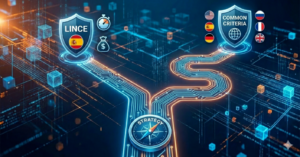
LINCE is a less expensive and faster certification, which translates to a lower use of human resources and work time for your development and security team.
If your product is intended for environments with ENS Medium certification, this scheme may be the most efficient option. Additionally, you always have the option to undergo a complementary LINCE evaluation and an annual vulnerability analysis to qualify for ENS High.
In contrast, Common Criteria involves a significant commitment of resources.
The security evaluation is much more in-depth, and therefore, the cost will be higher, not only due to consulting and evaluation fees but also because of the time your development and security team will have to dedicate to documentation, testing, and reviews.
Furthermore, the Common Criteria evaluation process includes additional steps, requiring more time from specialized personnel and dedicated resources.
Something to keep in mind is that if you opt for LINCE for your product or service to comply with ENS, and in the future, a Common Criteria certification is required due to international or legislative demands, it will have to be done from scratch.
Inclusion in CPSTIC: The Path to Public Administration
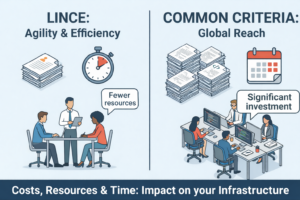
Inclusion in the CCN-CERT Catalogue of Products and Services (CPSTIC) is an important step, especially if your product targets the Spanish public sector.
LINCE is a faster way to achieve this inclusion, as the process is more agile and has fewer additional testing requirements. If your product must meet the requirements of the National Security Framework (ENS) at Medium or Low levels, LINCE is the ideal certification.
Additionally, there is always the option to transition to the ENS High level through a complementary LINCE evaluation and an annual update of the vulnerability analysis. This option is a good way to enter the catalogue with minimal investment and, once the demand for ENS High is assessed, to consider pursuing the complementary LINCE certification.
However, if you are aiming for an internationally recognized certification, Common Criteria opens doors to markets that require a more exhaustive security evaluation. International companies often agree on this option with their headquarters, because although the cost is higher, the international visibility and recognition are usually worth it.
The process for inclusion in CPSTIC is more complex, but the product would be listed in the catalogue directly for the ENS High level.
What Is the Right Choice for Your Product?
This is where business strategy becomes paramount. LINCE is perfect if your product is not intended for international markets. Conversely, if your product has a global projection, Common Criteria is the long-term option.
The choice will depend on these key factors:
- Time-to-market: If you need to launch quickly in local markets, LINCE is your best option.
- Available budget: If cost and time are limiting factors, LINCE offers a more economical certification.
- Expansion goals: If you have ambitions for international expansion, Common Criteria is the path most adapted to global demands.
Strategic Decisions for the Future of Your Product
At the end of the day, LINCE and Common Criteria are powerful tools, but each has a different strategic focus.
It is important to evaluate not only the cost and time but also the long-term impact the certification will have on your product and your business expansion.
If you have doubts about which is the best option for you, do not hesitate to contact Digital Cubes. We are here to help you make the best decision, aligned with your strategic objectives and technical requirements.